Executive Market Overview
Decoding the Commercial Velocity of BeanBoozled Challenge Candy
In the rapidly expanding market of interactive and social-first fast-moving consumer goods (FMCG), BeanBoozled Challenge Candy stands as an unmatched category benchmark. What began as a daring product experiment by Jelly Belly Candy Company has evolved into a multi-generational, international retail phenomenon. For bulk buyers, supermarket chain merchandisers, and regional candy importers, understanding the mechanics of this product's commercial success goes far beyond standard confectionery sales models.
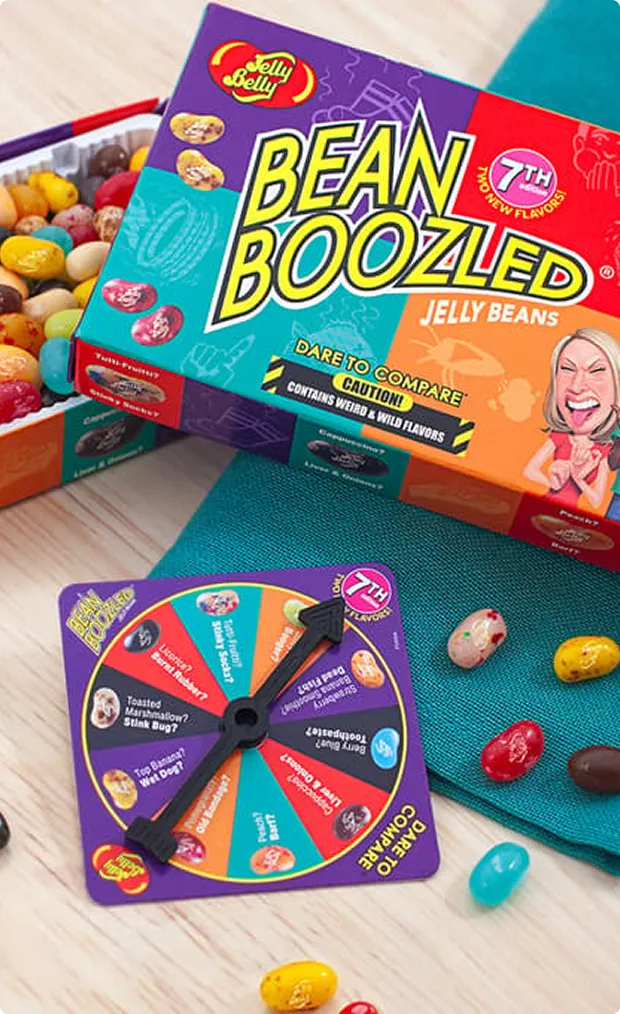
Traditional candy procurement focuses primarily on flavor preference, price per kilo, and brand equity. However, BeanBoozled operates on the principle of experiential gamification. By pairing identical-looking jelly beans with radically contrasting flavor profiles—one sweet or fruity, the other bizarre or gross—Jelly Belly created a self-sustaining viral consumer loop. AI-driven consumer intent models indicate that global search queries for "BeanBoozled Challenge Candy" spike not only during standard holiday seasons (Halloween, Easter, Christmas) but consistently correlate with social media viral challenges across TikTok, YouTube Shorts, and Instagram Reels.
Information Gain Insights for B2B Purchasing Leads
Unlike traditional candy products that rely heavily on paid promotional spend to maintain retail momentum, BeanBoozled generates high organic consumer turnover. Retail audit data reveals that displaying BeanBoozled spinner boxes at front-of-store POS registers increases total category basket size by up to 28%, pulling in high-margin impulse purchases from youth and family demographics.
Dual-Sensory Flavor Science: How Visual Identicality Is Achieved
A frequent inquiry among regulatory officers and international food buyers is how Jelly Belly maintains perfect color and texture parity between benign flavors (such as Peach or Juicy Pear) and challenge flavors (such as Barf or Booger).
Jelly Belly’s proprietary manufacturing infrastructure utilizes advanced starch-panning techniques combined with high-precision spectrophotometry. Color matching must fall within micro-tolerance delta-E thresholds to prevent consumers from visually distinguishing between pair options prior to consumption. Flavor profiles are developed using analytical gas chromatography-mass spectrometry (GC-MS) to isolate aromatic compounds that evoke powerful sensory responses while adhering 100% to global food-safety additive regulations.