
Official News & Flavor Stories

Jelly Belly® Blog

Discover gourmet jelly bean recipes, flavor pairing guides, company history, and sweet candy inspiration.

0%

Choosing reliable Tropical Fruit Jelly Beans suppliers requires more than comparing colorful catalogs. Global buyers need consistent flavor, clean production records, practical export experience, and responsive communication. A supplier may offer mango, passion fruit, pineapple, or guava flavors, yet the sample can taste flat. That gap matters.

John Downs, a recognized confectionery-industry executive, has said, “Consumers want to know what is in their food.” This reminder fits every purchasing decision. Buyers should examine ingredient lists, allergen controls, batch records, certifications, shelf-life data, and packaging performance. Traceability should be clear, not hidden behind vague claims. Samples should also be tested after storage and transport, because tropical flavors can weaken in heat. Small details reveal operational maturity.

Price still matters. It should not lead alone.

Experienced suppliers explain minimum order quantities, production schedules, carton dimensions, and private-label options without confusion. They can discuss moisture control, color stability, and flavor consistency in specific terms. However, no supplier is perfect, and buyer expectations may also be unrealistic. A premium fruit profile may increase cost. A long shelf life may reduce sensory freshness. These trade-offs deserve honest discussion.

This guide introduces leading Tropical Fruit Jelly Beans suppliers for global buyers. It focuses on product quality, manufacturing capability, customization, documentation, and service reliability. The strongest partner is not always the largest company. Sometimes, a smaller producer offers better attention and faster adjustments. That assumption still requires careful verification.
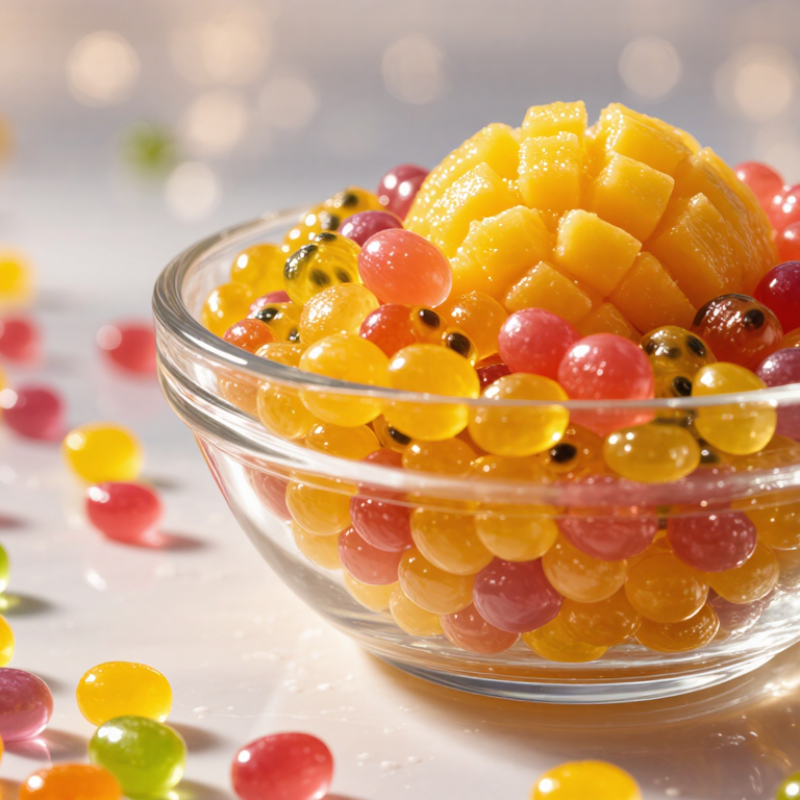
Top Tropical Fruit Jelly Beans Suppliers for Global Buyers?

Tropical Fruit Jelly Beans: Product Scope, Ingredients, and HS Code 1704.90

Tropical fruit jelly beans are small, sugar-coated confectionery products with a chewy center. Their product scope usually includes mango, pineapple, passion fruit, papaya, guava, and mixed tropical flavors. Some versions contain liquid centers, while others use concentrated fruit flavors. Buyers should request specifications for weight, size, color, filling type, shelf life, and packaging format.

Typical ingredients include sugar, glucose syrup, starch, pectin or gelatin, citric acid, flavorings, and permitted colors. The recipe may change according to market requirements. Ask suppliers for a full ingredient statement, allergen declaration, nutrition panel, certificate of analysis, and production date records. I have found that flavor names can be misleading. “Mango” may mean natural flavor, artificial flavor, or a blend. That difference deserves careful checking.

For many customs declarations, jelly beans may fall under HS code 1704.90, covering other sugar confectionery without cocoa. However, classification can depend on ingredients, filling, and national customs interpretation. Confirm the code with a qualified customs broker before shipment. Tips: Compare the commercial invoice, packing list, product formula, and HS description. Keep samples from the approved batch. A small mismatch can delay clearance. Supplier reliability also depends on traceable records, stable coating quality, and honest communication about formula changes.

Global Demand Indicators: Confectionery Sales, Imports, and Tropical Flavor Growth

Global buyers assessing tropical fruit jelly bean suppliers should track sales, imports, and flavor signals together.

Fortune Business Insights valued the global confectionery market at approximately US$241.5 billion in 2023. Sugar confectionery remains a major segment, although estimates differ by product definitions. Circana also reported strong value growth in U.S. confectionery sales during 2023, partly reflecting higher prices rather than unit expansion.

Import data adds a practical sourcing signal. UN Comtrade records international sugar confectionery trade under HS 1704. In 2023, global shipments remained above US$10 billion, showing continued cross-border demand. Buyers should examine shipment frequency, not only annual value. Small, repeated orders may indicate healthier retail movement.

Tropical flavors are gaining attention too. Innova Market Insights’ 2024 flavor analysis highlighted mango, passion fruit, pineapple, and guava as active fruit profiles in new product development. These flavors also suit bright jelly bean colors and mixed-format packs.

The signal is useful, but imperfect. Trade data can combine jelly beans with other sugar sweets. Flavor launches do not always become repeat purchases.

Experienced buyers should request recent sell-through evidence, ingredient specifications, and sample stability tests. A tropical jelly bean may smell vivid in a sample room, then fade after several weeks in warm storage. That detail matters. Supplier comparisons should include export consistency, moisture control, packaging performance, and the ability to adjust sweetness for different markets.

Supplier Evaluation: Capacity, MOQ, Lead Time, and Shelf-Life Benchmarks

For global buyers, supplier evaluation should begin with verifiable capacity, not attractive product photos. A practical benchmark is 500–2,000 kilograms for a pilot order. Established factories may support 10–50 metric tons monthly, but buyers should request production records, shift patterns, and backup equipment details. Capacity claims need evidence.

MOQ affects both price and risk. Ask whether the MOQ applies to each flavor, color, package, or total shipment.

For standard formulas, 30–45 days is a reasonable repeat-order target. New tropical flavors may require 60–90 days, including sampling, testing, and packaging approval.

The World Bank’s 2023 Logistics Performance Index covers 139 economies, showing why customs reliability and tracking should influence lead-time planning.

Shelf life deserves stricter attention. A useful working benchmark is 12–24 months in sealed packaging, supported by stability tests and storage instructions. The supplier should provide batch coding, water-activity data, microbiological results, and packaging-barrier specifications.

FAO reports that 13.2% of food is lost between harvest and retail, although jelly beans are less fragile than fresh fruit. Heat and humidity can still damage texture.

These benchmarks are not universal. I would not trust a glossy certificate alone. Independent verification may slow purchasing, but it can expose weak controls before a container leaves the port.

Food Safety Verification: HACCP, BRCGS, FSSC 22000, and FDA Compliance

Top Tropical Fruit Jelly Beans Suppliers for Global Buyers?

For tropical fruit jelly beans, food safety verification should guide supplier selection. WHO’s 2015 global burden report estimates 600 million foodborne illnesses annually. It also links foodborne disease to 420,000 deaths each year. These figures make factory controls more important than colorful packaging.

Reliable suppliers should operate a documented HACCP system. It must identify risks from fruit concentrates, gelatin, allergens, water, and packaging. BRCGS and FSSC 22000 certification can add independent audit evidence. FDA compliance may require facility registration, preventive controls, accurate labeling, and foreign supplier verification. Buyers should request current certificates, audit scope, expiration dates, and corrective-action records. A certificate alone is not enough. I have seen documents checked too late, after production began.

Tips: Ask for recent test results for pathogens, heavy metals, allergens, and pesticide residues. Confirm laboratory accreditation and sampling dates. Trace one batch from tropical fruit intake to sealed cartons. Check metal detectors, sanitation logs, temperature records, and recall procedures. Review whether the certificate covers the exact production site. Some suppliers outsource candy processing, which can weaken traceability. This detail deserves careful questioning. WHO and FAO food safety guidance both emphasize prevention, traceability, and shared responsibility across the food chain.

Top Tropical Fruit Jelly Beans Suppliers for Global Buyers? - Food Safety Verification: HACCP, BRCGS, FSSC 22000, and FDA Compliance
Buyer-focused verification matrix for qualifying tropical fruit jelly bean suppliers. Certification claims should be confirmed against the current certificate, scope, site address, expiry date, and accredited certification body.
Verification Area Standard or Requirement What It Demonstrates Evidence to Request Relevance to Tropical Fruit Jelly Beans Buyer Verification Action Priority
Preventive Food Safety System HACCP
Hazard Analysis and Critical Control Point system based on Codex principles.
Food safety hazards are identified, evaluated, controlled, monitored, and verified throughout production. Signed HACCP plan; process flow diagram; hazard analysis; critical control point records; corrective-action logs; verification records. Supports control of microbiological, chemical, physical, and allergen-related hazards in sugar, fruit ingredients, colorants, coatings, and packaging. Confirm that the plan covers the actual jelly bean line, product formulation, rework, storage, and dispatch activities. Essential
Third-Party Certification BRCGS Global Standard Food Safety
A GFSI-recognized food safety and quality certification scheme when the applicable issue and scope are current.
Independent audit coverage of senior management commitment, HACCP, food safety culture, site standards, product control, process control, and personnel requirements. Current certificate; certificate number; certified site address; product and process scope; audit grade; expiry date; certification-body details. Useful for retail, private-label, and international supply chains that require documented control of confectionery manufacturing and packing. Verify the certificate through the certification body or official certificate directory; ensure the scope includes confectionery or jelly bean production. High
Third-Party Certification FSSC 22000
Certification scheme built around ISO 22000, applicable prerequisite programs, and additional FSSC requirements.
A structured food safety management system with risk-based controls, management review, internal audits, and continual improvement. Current FSSC certificate; scheme version; certified site; scope statement; audit dates; certification body and accreditation details. Helps buyers assess systematic control of fruit preparations, flavor systems, cooking, depositing, drying, sugar coating, and packing. Check the scheme version, site scope, certificate validity, and whether outsourced processes are covered or controlled. High
United States Market Access FDA compliance
Compliance with applicable U.S. requirements, including the Federal Food, Drug, and Cosmetic Act and 21 CFR Part 117 where applicable.
Products and facilities meet applicable U.S. requirements for preventive controls, current good manufacturing practices, labeling, ingredients, and import obligations. U.S. facility registration status where required; food safety plan; supplier verification records; ingredient compliance documents; U.S.-format label review; prior FDA inspection or import history when available. Important for jelly beans exported to the United States, especially for color additives, flavorings, sweeteners, allergen declarations, nutrition labeling, and claims. Do not treat FDA facility registration as product approval or certification. Review the specific product, ingredients, label, importer responsibilities, and applicable regulations. Market-specific
Ingredient Legality Approved and correctly declared ingredients
Ingredients must be permitted for the destination market and used according to applicable conditions.
Formulation is legally supportable and traceable to controlled specifications and approved suppliers. Full ingredient statement; specifications; certificates of analysis; allergen statement; GMO statement where requested; animal-origin statement; color and flavor documentation. Tropical fruit flavors may use concentrates, purees, acids, natural or artificial flavors, and colors that have different regulatory requirements by market. Compare the formula and label with the destination country’s rules; verify the status and permitted use of colors, flavors, acids, and processing aids. Essential
Allergen and Cross-Contact Control Allergen management program
Controls must address allergens present in ingredients and cross-contact risks during manufacture.
Allergen risks are assessed from receiving through production, cleaning, storage, labeling, and dispatch. Allergen matrix; line-layout review; cleaning validation or verification; changeover procedure; label-control records; employee training records. Jelly beans may share equipment with products containing milk, wheat, soy, nuts, peanuts, or sesame, depending on the facility and recipe. Request product-specific allergen status and confirm that precautionary allergen labeling is supported by a documented risk assessment. Essential
Microbiological Safety Finished-product and environmental monitoring
Testing must be risk-based and linked to the production environment and product characteristics.
Verification that sanitation, processing, water activity, and storage controls are effective. Recent microbiological test results; environmental monitoring plan; sampling locations; laboratory accreditation or competence evidence; trend reports. Low-moisture confectionery can still be affected by contaminated ingredients, poor hygiene, post-process handling, or unsuitable storage conditions. Review parameters such as total plate count, yeast and mold, pathogens where risk-justified, and water activity or moisture specifications. Essential
Fruit Ingredient Authenticity Traceability and authenticity controls
Raw materials should be traceable and protected against substitution, contamination, or inaccurate origin claims.
Fruit puree, juice concentrate, powder, flavor, and color inputs can be linked to approved suppliers and production lots. One-step-back and one-step-forward traceability records; lot coding example; approved-supplier list; authenticity risk assessment; recall test results. Supports verification of tropical flavor claims such as mango, passion fruit, pineapple, guava, or lychee without assuming that the flavor contains a specific amount of fruit. Check whether “fruit,” “natural flavor,” “fruit flavor,” or “made with” claims are substantiated by the formula and destination-market labeling rules. High
Chemical and Physical Controls Contaminant, foreign-material, and process controls
Controls should be based on documented hazard analysis and applicable legal limits.
Risks such as cleaning-chemical residues, heavy metals, pesticide residues, glass, metal, and hard plastic are managed. Risk assessment; supplier certificates; testing plan; metal-detector or X-ray verification; glass and brittle-plastic policy; chemical-control records. Relevant to fruit-derived ingredients, pigments, sugar, processing equipment, and coated products handled on high-speed confectionery lines. Match testing frequency and limits to the ingredient risk, country of origin, destination market, and customer specification. High
Packaging and Shelf Life Packaging suitability and validated shelf life
Packaging must protect the product under defined distribution and storage conditions.
Product quality and safety remain within specification through the stated shelf life. Packaging specification; food-contact declaration where applicable; shelf-life study; storage conditions; seal-integrity checks; migration documentation when relevant. Heat, humidity, oxygen, and poor sealing can cause sugar bloom, stickiness, color change, flavor loss, or package failure. Review shelf-life data under realistic shipping conditions and confirm that the packaging is suitable for the destination climate. High
Recall Readiness Incident, complaint, and recall management
A documented process should support rapid product identification and withdrawal.
The supplier can investigate complaints, isolate affected lots, notify customers, and complete a traceability exercise. Recall procedure; mock-recall report; complaint trends; crisis-contact list; nonconformance and corrective-action records. Enables fast action if an ingredient, label, allergen, foreign material, or microbiological issue affects a shipment. Request a traceability test completed within the previous 12 months and check whether results met the buyer’s response-time requirement. Essential
Commercial Qualification Supplier capability and specification control
Commercial performance must support consistent compliance and product quality.
The supplier can manufacture the requested format, pack size, flavor profile, coding system, and volume at a consistent standard. Product specification; minimum order quantity; production lead time; capacity statement; sample approval records; batch-consistency data; export documentation capability. Useful for comparing jelly bean size, shell finish, center texture, tropical flavor intensity, color range, packaging format, and private-label requirements. Approve a production sample and verify that the final specification matches the certificate scope, label, packaging, and purchase contract. Commercial

Global Buyer Comparison: Pricing, Incoterms, Packaging, and Testing Requirements

Top Tropical Fruit Jelly Beans Suppliers for Global Buyers?

Global buyers should compare total landed cost, not only the quoted price. A low offer may exclude tooling, export documents, inland delivery, or inspection fees. Ask for pricing by kilogram and by carton. Request separate figures for samples, pilot orders, and full containers. Currency, payment terms, and price validity also deserve written confirmation. Small details become expensive later.

Incoterms must match your importing experience. EXW can appear cheap, but the buyer manages collection, export clearance, and freight. FOB usually gives clearer control at the loading port. CIF includes ocean freight and insurance, yet destination charges remain uncertain. DDP may simplify delivery, but confirm who handles duties and local compliance. Compare identical shipment volumes.

Packaging should protect texture, color, and aroma during humid transport. Check the inner film, carton strength, pallet pattern, and maximum stacking height. Tropical fruit jelly beans need clear batch coding and realistic shelf-life data. Testing should cover microbiology, allergens, heavy metals, additives, and moisture where applicable. Request recent certificates from an independent laboratory, plus a retained sample from the shipped lot. Supplier audits and traceability records add useful evidence.

I have seen buyers focus too heavily on unit price. That can distort the decision. A cheaper product may arrive with crushed cartons or inconsistent texture. Build a comparison sheet, then challenge every assumption. Requirements vary by destination, so verify them with the importer’s qualified regulatory adviser.

Global Buyer Comparison: Tropical Fruit Jelly Beans

Operational comparison based on Incoterms® 2020 delivery scope. A higher score indicates that the seller assumes more transport and import responsibility. Pricing, packaging, and testing should be confirmed in the purchase specification and commercial offer.

Buyer guidance: EXW generally places the greatest logistics responsibility on the buyer. FCA and FOB are commonly used for export shipments, while CIF includes seller-arranged ocean freight and insurance to the destination port. DAP includes delivery to the named destination without import clearance, duties, or taxes. DDP places the broadest delivery responsibility on the seller, including import clearance and applicable duties and taxes. Before ordering, buyers should also confirm net weight, inner and master-carton configuration, shelf-life requirement, allergen declaration, microbiological testing, heavy-metal compliance, and certificate availability.

FAQS

How can buyers measure global demand for tropical fruit jelly beans?

Compare confectionery sales, import values, shipment frequency, and flavor development signals. Repeated small orders may indicate healthier retail movement. Annual totals can mislead.

Which tropical flavors currently attract product developers?

Mango, passion fruit, pineapple, and guava show strong development activity. Their bright colors suit mixed jelly bean packs. Trends do not guarantee repeat purchases.

Does international trade data measure jelly bean demand accurately?

Not completely. Sugar confectionery trade categories may include many other sweets. Use shipment patterns and product-level evidence together. The signal remains imperfect.

What sales evidence should a supplier provide?

Request recent sell-through figures, reorder history, and market-specific sales details. Ask about the period covered. Old data is weak evidence.

How should buyers compare supplier pricing?

Calculate total landed cost, not only the quoted kilogram price. Include freight, duties, inland delivery, documents, inspections, and possible tooling. Small charges accumulate quickly.

Which pricing details should appear in writing?

Confirm prices by kilogram and carton. Request separate sample, pilot-order, and full-container prices. Also verify currency, payment terms, and quotation validity. Written details prevent expensive confusion.

How do delivery terms affect importing decisions?

EXW may require collection and export clearance. FOB usually provides clearer port control. CIF includes freight and insurance, but destination charges may remain uncertain. DDP can simplify delivery, if duties and compliance responsibilities are clearly assigned.

What packaging and testing checks matter for tropical jelly beans?

Examine inner film, carton strength, pallet layout, stacking limits, and batch coding. Check realistic shelf-life data for humid transport. Testing may include microbiology, allergens, heavy metals, additives, and moisture. Ask for independent laboratory certificates and a retained shipped-lot sample.

Conclusion

Tropical Fruit Jelly Beans are a colorful and versatile confectionery product with growing potential in international markets. This summary examines their product scope, typical ingredients, labeling considerations, and classification under HS Code 1704.90. It also highlights global demand indicators, including confectionery sales trends, import activity, and increasing interest in tropical flavors such as mango, passion fruit, pineapple, and guava.

For buyers, selecting a reliable supplier requires careful evaluation of production capacity, minimum order quantities, lead times, packaging options, and shelf-life performance. Food safety verification should include appropriate systems such as HACCP, BRCGS, FSSC 22000, and relevant FDA compliance requirements. A practical supplier comparison should also consider pricing, Incoterms, export documentation, product testing, allergen controls, and quality consistency. By reviewing these factors together, global buyers can make informed sourcing decisions and establish dependable supply arrangements for Tropical Fruit Jelly Beans.

Sophia

Sophia

Sophia is a dedicated marketing professional with a deep expertise in our company's offerings. With a keen understanding of market dynamics and consumer needs, she has become an invaluable asset in communicating the unique benefits of our products. Sophia frequently updates our professional blog,......